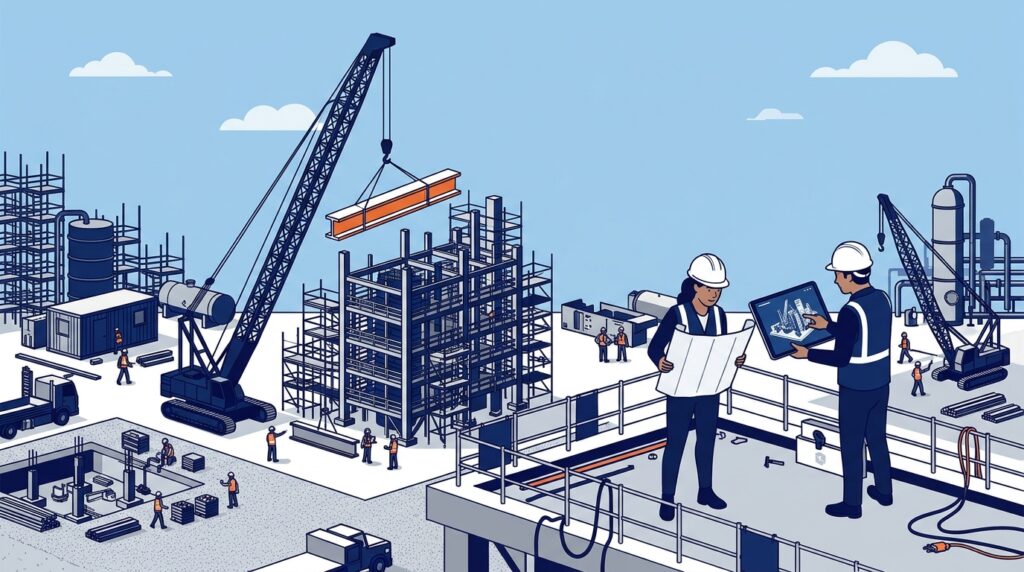
Construction is where a plant moves from drawings to reality—and where safety, schedule, cost, and quality risks converge. For small to medium-scale plants, with less margin for error, effective construction management is what makes the difference.
Pre-Construction Planning
The foundation of success. Key activities:
- Scope definition — what work is included?
- Constructability review — is the design buildable? Any conflicts, access or crane issues, lead-time problems? Conducted during design, when changes are still cheap.
- Schedule and budget development
- Contractor selection — capability, safety record, financial strength, not price alone
- Regulatory approvals, site prep, logistics
- Safety planning and risk assessment — weather, ground conditions, deliveries, labor
Sequencing and Organization
Typical sequencing logic:
- Underground utilities and foundations before structures above them
- Heavy equipment (turbines, vessels) before surrounding work closes off crane access
- Large-bore piping and steel before small-bore piping, cable trays, instrumentation
- Work by system, so areas hand over to commissioning in the order it’s needed
All key functions—planning, cost, quality, safety, procurement, documentation—must be covered, even if roles are combined on small plants. Authority lines must be clear before mobilization.
Managing the Work
Contractor management: Pre-qualify, define requirements in the contract, verify mobilization, supervise performance, and require method statements for high-risk activities like heavy lifts.
Interface management: Use an interface register, regular coordination meetings, and area-based planning to resolve conflicts between disciplines, contractors, and commissioning.
Temporary facilities: Site offices, laydown areas, utilities, access, and waste handling—planned so they don’t interfere with permanent works.
The Four Controls
Schedule: Baseline schedule, objective progress measurement, critical path analysis, three-week look-aheads, recovery planning.
Cost: Track commitments and actuals, forecast final costs, disciplined change control. Evaluate cost and schedule together so problems surface early.
Quality: Quality plan, inspection and test plans with hold/witness points, non-conformance management. Inspect work as it’s completed—defects are cheaper to fix before later work buries them.
Safety (highest priority): Hazard identification, permit-to-work (hot work, confined space, work at height, lifting), training and induction, PPE, inspections, incident reporting. Safety must be built into every activity, not added afterward.
Materials and Documentation
Materials: Procurement, expediting, inspection, logistics, storage, and issue—so materials arrive when needed and in good condition. Rotating equipment and instruments often need special preservation; neglect can void warranties.
Documentation: As-built drawings, inspection and test records, change orders, safety records. Collect records as work is completed—reconstructing them later is painful and often incomplete.
Changes and Closeout
Change management: Identify, assess impact (scope, schedule, cost, quality, safety), approve, implement, document. Uncontrolled changes cause scope creep and overruns.
Closeout (planned as part of construction, not left to the end):
- Punch list (before vs. after commissioning)
- Mechanical completion verification
- As-built documentation
- Progressive system-by-system handover to commissioning
- Demobilization and housekeeping
Progressive handover lets commissioning start earlier and reduces the end-of-project crunch.
Common Mistakes
- Starting construction before planning is complete
- Weak constructability review
- Unclear scope → disputes and changes
- Choosing contractors on price alone
- Poor interface management and sequencing
- Delays and cost overruns detected too late
- Safety shortcuts
- Incomplete documentation
- Not capturing lessons learned
Conclusion
Construction management means delivering the plant safely, on schedule, within budget, and to quality. With less room for error on small and medium plants, disciplined planning, constructability review, sequencing, and control of contractors, interfaces, schedule, cost, quality, and safety make the difference between a smooth startup and a costly one.