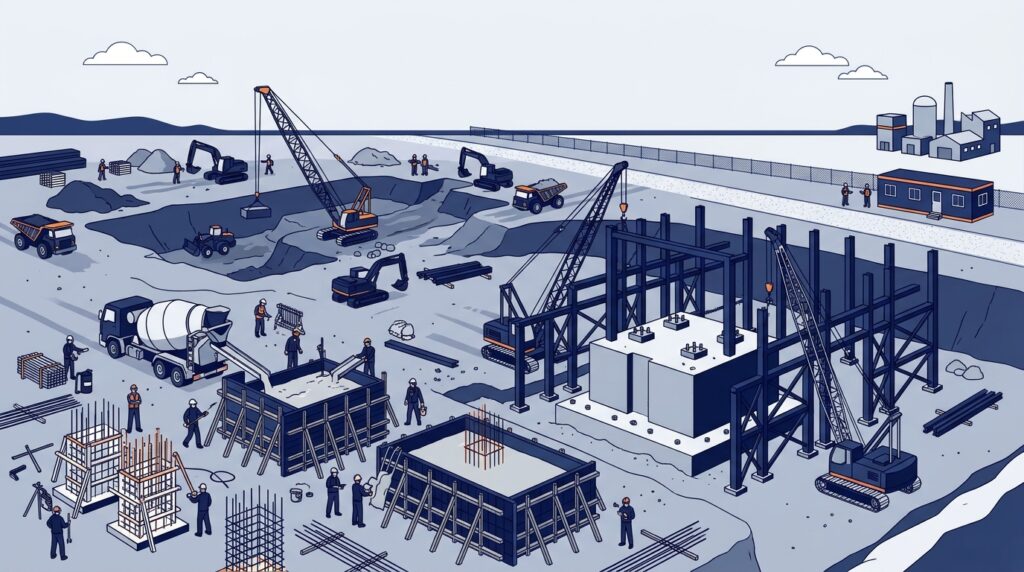
Civil engineering is the foundation of every industrial plant, literally. Foundations support the equipment. Structures house the process. Roads provide access. Drainage protects the site. All of it must withstand site conditions, plant loads, and the test of time—and every project reinforces the same lesson: civil engineering is not a secondary discipline. It is fundamental to project success.
What Is Plant Civil Engineering?
The discipline of designing and constructing the civil works required for an industrial plant:
- Site preparation: Earthworks, grading, and compaction
- Foundations: Supporting equipment, structures, and buildings
- Structures: Buildings, pipe racks, platforms, shelters
- Roads and access: Site roads, heavy haul routes, hardstanding
- Drainage: Stormwater, process, and contaminated drainage
- Underground services: Pits, trenches, culverts, buried piping and cables
- Retaining structures: Walls, slopes, embankments
- Marine works: Intakes, outfalls, breakwaters (coastal sites)
All other disciplines depend on this platform. Poor civil engineering means structural failures, rework, settlement, vibration, and premature deterioration.
Design Basis, Codes, and Standards
Civil design starts with a clear design basis, agreed early: applicable codes (ACI, ASCE, Eurocode, local codes), design loads (dead, live, wind, seismic, thermal, equipment), environmental conditions, equipment vendor data, and design life. Where owner standards, local regulations, and vendor requirements conflict, the design basis should state which governs.
Geotechnical Investigation
The basis of all civil design: boreholes, test pits, in-situ testing (SPT, CPT), laboratory testing (including chemical tests for sulfate and chloride), and groundwater monitoring—covering the whole plant footprint, with denser coverage under heavy equipment like turbine-generators. The quality of early geotechnical work determines how smoothly construction goes.
Seismic and Geohazards
Many plant sites lie in seismically active or geologically complex regions. Identify early: seismic loading, liquefaction, slope stability, volcanic and geothermal ground conditions, and flood or tsunami exposure. These affect foundation type, structural system, and site layout—and are far cheaper to address in design than in construction.
Foundations
Foundation type depends on soil, loads, and equipment requirements:
- Shallow foundations (spread footings): good soil, moderate loads
- Raft/mat foundations: uniform loads, weaker soil
- Deep foundations (piles, drilled shafts): poor soil, heavy loads, liquefaction risk
- Machine foundations: dynamic loads for turbines and compressors
- Tank foundations: where settlement is critical
Machine foundations deserve special attention: natural frequencies must stay clear of operating frequencies; vibration must be isolated from surrounding structures; alignment and settlement must be controlled; and grouting and anchor bolts must follow vendor requirements.
Structures, Roads, and Drainage
Structures: Buildings, process structures, and special structures (stacks, cooling towers) must consider loads, fire protection, local construction capability, and corrosion exposure.
Roads: Include heavy haul routes—checking bridges, turning radii, and overhead clearances for large equipment deliveries. At remote sites, access roads and logistics planning are often critical to construction success.
Drainage: Stormwater, process, and contaminated drainage (with containment and treatment), plus flood protection and erosion control.
Underground Services, Retaining Structures, Marine Works
Underground services are easy to overlook and difficult to change once built—coordinate routes, crossings, and depths with piping and electrical teams before foundations and roads are constructed.
Retaining structures (gravity, cantilever, sheet pile, gabion, soil nailing) are often needed where sites have significant level changes.
Marine works (intakes, outfalls, breakwaters, jetties) demand additional data—bathymetry, tides, waves, currents—and design for aggressive marine environments.
Concrete, Quality Control, and Sequencing
Good design can be undone by poor construction quality. Key practices: concrete mix design matched to exposure (sulfates, seawater, high temperatures), testing, inspection hold points before every pour, curing and temperature control, and as-built survey of foundations and anchor bolts.
Because civil works come first, delays and errors spread everywhere. Practical measures: secure vendor loads early, resolve clashes between foundations and underground services during design, sequence excavations and pours so civil work doesn’t block equipment delivery, and define clear acceptance criteria for foundation handover.
Civil Engineering in Small Plants
Small plants face fewer resources, less geotechnical data, and less in-house expertise. Practical responses: invest in geotechnical investigation, use standard designs, seek expert advice, plan civil works around the construction sequence, document decisions, and design for durability and low maintenance. Civil engineering does not need to be complex—it needs to be thorough and practical.
Common Mistakes
- Insufficient geotechnical investigation—discovering soil problems after construction begins
- Poor compaction and site preparation leading to settlement
- Underestimating drainage—flooding during construction or operation
- Ignoring seismic conditions
- Poor machine foundation design—vibration and misalignment
- Late equipment data—rework when vendor loads change
- Inadequate access roads blocking equipment delivery
- Weak concrete quality control—defects surfacing after commissioning
- No construction sequencing plan—civil works blocking other disciplines
These mistakes are costly to correct and much cheaper to avoid through disciplined engineering.
Conclusion
Civil engineering determines whether a plant can be built safely, operated reliably, and maintained economically. By focusing on the design basis, geotechnical investigation, foundations, structures, drainage, and quality control, owners and project teams ensure the civil works support the plant throughout its life.