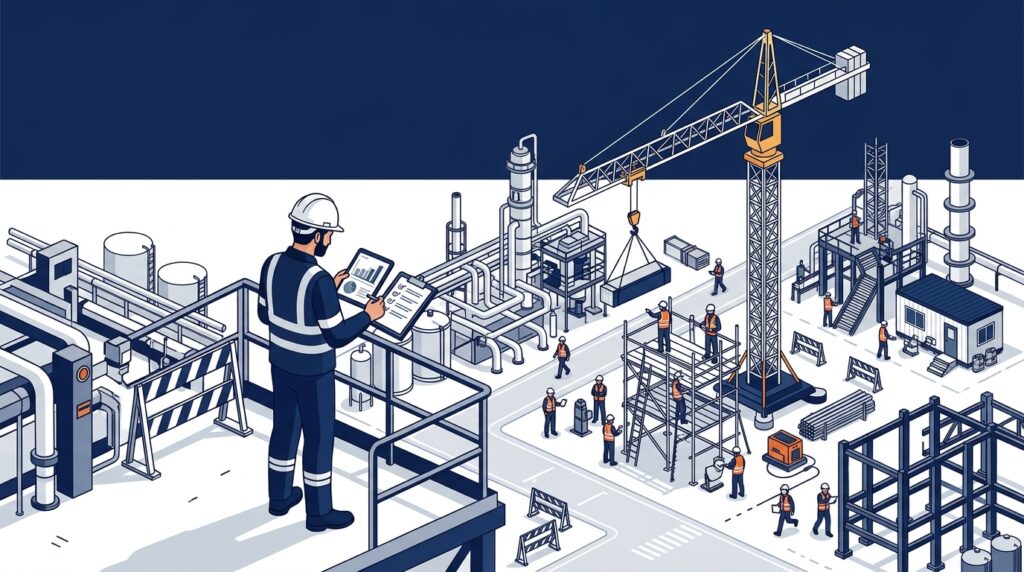
Construction supervision is the discipline of overseeing construction activities so that work is performed safely, on schedule, within budget, and to the required quality. It is the bridge between the design office and the construction site—where drawings become physical reality, and where problems are found and resolved before they become costly.
What Construction Supervision Covers
- Safety supervision: ensuring work is performed safely
- Quality supervision: ensuring work meets specifications
- Schedule supervision: ensuring work is completed on time
- Cost supervision: ensuring work stays within budget
- Coordination: ensuring disciplines and contractors work together
- Documentation: ensuring construction records are complete
Poor supervision means incidents, rework, delays, cost overruns, and incomplete handover records. For small to medium-scale plants with little margin for error, supervision determines whether the plant is built correctly and safely.
Setting Up: The Supervision Plan
Effective supervision starts before construction begins. A supervision plan should define organization and reporting lines, staffing by discipline and phase, inspection and test requirements (ITPs), the permit-to-work system, progress measurement methods, interface procedures, and document control. The supervisor must also have clear authority—including the authority to stop unsafe or non-conforming work.
Safety Supervision
The highest priority. Key activities: hazard identification, regular safety inspections, daily toolbox talks, incident and near-miss reporting, and emergency response.
Permit-to-work deserves particular attention. It is effective only when permits are issued for a defined scope, hazards and isolations are verified in the field, and permits are closed out properly. Typical permit-controlled activities: hot work, confined space entry, work at height, excavation, lifting operations, energized electrical work, and line breaking. Safety supervision should be proactive—addressing hazards before they cause incidents.
Quality Supervision
Ensures work meets specifications: inspect work as it is completed, before it is covered or closed; witness tests; verify material certificates and traceability; manage non-conformances; keep quality records.
Quality supervision should be based on inspection and test plans (ITPs) defining:
- Hold points: work must stop until inspection is passed (e.g., before concrete is poured)
- Witness points: supervisor may attend, but work can proceed
- Review points: records reviewed after the activity
Typical focus areas: foundations and civil works, structural steel, equipment installation and alignment, welding and NDT, pressure testing, piping cleaning and flushing, and electrical and instrument installation.
Schedule and Cost Supervision
Schedule: Track progress against a realistic baseline using measured data—not estimated percentages. Use two-to-four-week look-ahead plans, monitor the critical path, identify delays early, and develop recovery plans.
Cost: Track commitments and actuals, enforce disciplined change control, and forecast final costs. Verbal instructions with cost implications must be documented and approved before work proceeds.
Coordination and Issue Resolution
Coordination: Manage interfaces between disciplines and contractors through regular coordination meetings, area-based work planning, defined handover procedures, and oversight of subcontractor manpower, equipment, and compliance. Coordination matters most on complex projects with multiple contractors working in the same areas.
Issue resolution: Identify problems early, analyze root causes, develop practical solutions with designer input where needed, implement, and verify. An unresolved site issue gets more expensive every day.
Documentation
Complete, accurate, accessible records: daily reports (activities, manpower, weather, progress, issues), inspection and test records, non-conformance reports, as-built drawings, and photographs. Records not captured during construction are very hard to reconstruct later.
From Construction to Commissioning
Supervision does not end when installation looks finished. Supervisors play a key role in the transition:
- Verify mechanical completion against defined criteria
- Manage the punch list, categorized by priority
- Confirm completion of pressure tests, flushing, and cleaning
- Organize system-by-system turnover
- Ensure documentation is ready for handover
A well-managed transition reduces delays during commissioning and startup.
Supervision in Small Plants
Small plants face fewer resources, less expertise, and limited specialist support. Practical approaches: focus supervision on critical activities where failure would be most costly or dangerous; use simple checklists; engage third-party inspectors for specialized work; document everything; train staff; and apply lessons from other plants. Supervision does not need to be complex—it needs to be thorough and consistent.
Common Mistakes
- Inadequate safety oversight → incidents
- Skipping inspections → defective work buried
- Poor progress monitoring → delays discovered too late
- Weak cost control → overruns missed
- Poor coordination → conflicts between contractors
- Delayed issue resolution → problems escalate
- Incomplete documentation → problems at handover
- No lessons learned → mistakes repeated
Conclusion
Construction supervision determines whether a plant is built correctly and safely. By focusing on safety, quality, schedule, cost, coordination, issue resolution, and documentation—supported by a solid supervision plan—owners and project teams ensure the plant is built as designed and ready for a smooth commissioning and startup.